

19 AI Models Are Scheduled for Retirement: Why "-latest" Isn't Forever
End-of-life dates for 19 AI models across OpenAI, Gemini and Anthropic, tracked 6 July to 3 August 2026. Five have already passed.
On 23 July 2026, gpt-5-chat-latest reached end of life. So did gpt-5-codex. Two weeks earlier, GPT-5.6 had launched.
Between 6 July and 3 August 2026 we tracked 1,204 releases across 20 platforms. Buried in them were end-of-life dates for 19 distinct AI models from three vendors. Five of those dates have already passed. The rest fall between now and 23 October 2026. All of them are on the ReleaseBytes EOL tracker.
If you are treating a model ID as a stable configuration value, this is the article for you.
What we found
Nineteen models crossed an end-of-life threshold on our tracker during the window - meaning they hit 90, 30, 7 or zero days from retirement. Twelve came from OpenAI, six from Gemini and one from Anthropic. Here is every one, ordered by the date it dies.
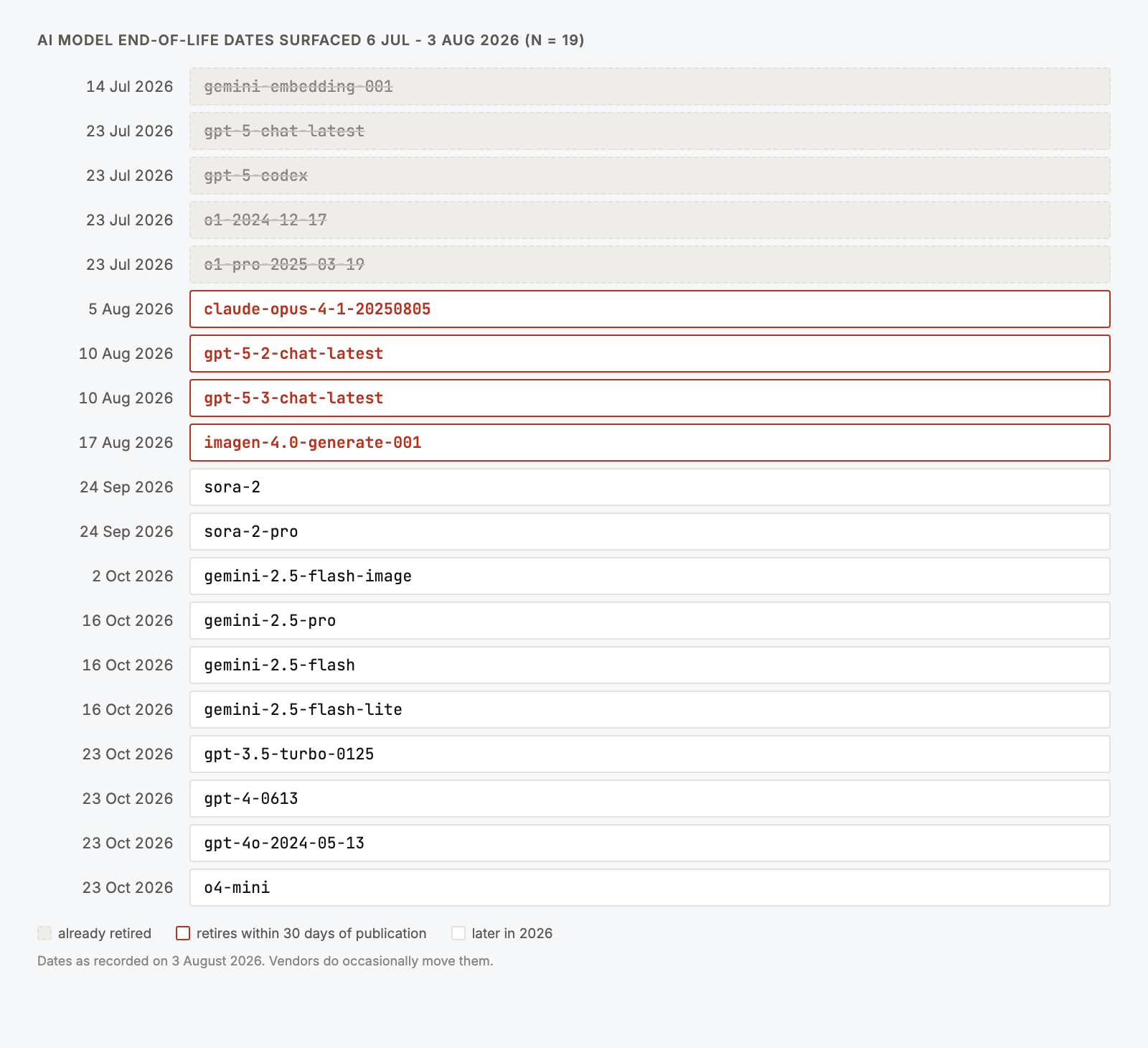
Grouped by date, and by whether the date has already passed:
- Already retired. 14 Jul:
gemini-embedding-001. 23 Jul:gpt-5-chat-latest,gpt-5-codex,o1-2024-12-17,o1-pro-2025-03-19. - Retiring within 30 days of publication. 5 Aug:
claude-opus-4-1-20250805. 10 Aug:gpt-5-2-chat-latest,gpt-5-3-chat-latest. 17 Aug:imagen-4.0-generate-001. - Later in 2026. 24 Sep:
sora-2,sora-2-pro. 2 Oct:gemini-2.5-flash-image. 16 Oct:gemini-2.5-pro,gemini-2.5-flash,gemini-2.5-flash-lite. 23 Oct:gpt-3.5-turbo-0125,gpt-4-0613,gpt-4o-2024-05-13,o4-mini.
Status is as at 3 August 2026. Vendors do occasionally move these dates - two Redis end-of-life dates shifted during this same window.
Counted by vendor, that is 12 models from OpenAI, 6 from Gemini and 1 from Anthropic. These are distinct models, not tracker entries: the same model generates several entries as it passes 90, 30 and 7 days out.
Key trends
The "-latest" alias is not evergreen
Three of the nineteen are alias identifiers: gpt-5-chat-latest, gpt-5-2-chat-latest and gpt-5-3-chat-latest. The first died on 23 July. The other two die on 10 August.
The naming invites a reasonable assumption - that pointing at -latest means never having to think about versions again. In practice each -latest alias is itself a versioned artifact with its own retirement date, and a newer alias supersedes it. Pinning to an alias does not remove the upgrade. It just removes your visibility of when it lands.
Retirement now overlaps with launch
The same 29-day window contained six new model families or major releases.
| Date | Launch |
|---|---|
| 9 Jul | OpenAI GPT-5.6, on Bedrock by 13 Jul - covered in that week's digest |
| 10 Jul | Claude Sonnet 5, later on Bedrock in GovCloud |
| 21 Jul | Gemini 3.6 Flash, in Gemini Enterprise and GitHub Copilot the same day |
| 24 Jul | Claude Opus 5 |
| 28 Jul | Grok 4.5 in GitHub Copilot |
| 30 Jul | Gemma 4 on Amazon Bedrock, GovCloud US-West |
Set the two lists side by side and the compression is obvious. GPT-5.6 launched on 9 July. Fourteen days later, gpt-5-chat-latest and gpt-5-codex were gone. The generation that replaces a model and the retirement of that model now arrive in the same month, not the same year. Anthropic's claude-opus-4-1-20250805 retires on 5 August, twelve days after Opus 5 shipped.
Distribution is instant. Removal is your problem.
Claude Opus 5 is the clearest example of how fast a new model propagates. On 24 July, its launch day, it appeared on Anthropic's own API, Amazon Bedrock with zero data retention, Google Cloud's Gemini Enterprise Agent Platform, Snowflake Cortex AI and GitHub Copilot, and became the default in Claude Code. Azure Databricks followed on 27 July. We wrote that week up as The Enterprise AI Agent Era Begins.
That is six surfaces in a day. The asymmetry is that arrival is done for you and departure is not. When a model retires, every pinned reference in your code, your Bedrock configuration, your Copilot policy and your CI templates is a separate thing someone has to find and change.
What engineers should care about
Treat model IDs as dependencies with expiry dates, not as configuration. A model string sitting in an environment variable has more in common with a pinned package version than with a feature flag. It has a publisher, a version and, as this data shows, a support window.
Inventory where the strings live. The count that matters is not how many models you use, it is how many places each one is written down. Application code, infrastructure-as-code, cloud console settings, notebooks and CI configuration all tend to hold their own copy.
Put the dates in a calendar, not in someone's memory. Nineteen models, three vendors, six distinct retirement dates in the next three months. That is not something to rediscover through a failing API call. We track every one of these on the EOL tracker, and you can have them delivered at 90, 30 and 7 days out rather than checking manually.
Prefer explicit versions to aliases when stability matters. A dated identifier like gpt-4o-2024-05-13 tells you exactly what you are calling and can be checked against a retirement list. An alias hides the change until it happens.
The wider picture
Model churn is not the only lifecycle pressure in the data. Across the same window we recorded 138 deprecation entries in total, covering 59 distinct products once the repeated countdown entries are removed - databases, Kubernetes versions, runtimes and monitoring stacks alongside the models. Against that, only 29 releases were classified as breaking.
The ratio is the point. Most of what a platform team absorbs is not adapting to APIs that changed. It is retiring things on someone else's schedule, published on someone else's changelog. That is the reason we publish a weekly digest every Monday: the retirements are individually small and collectively relentless, and they are easy to miss one changelog at a time. The four editions covering this window were 6-12 July, 13-19 July, 20-26 July and 27 July - 2 August.
Keep exploring
Stay current without the tab-hopping
One weekly digest with the most notable cloud, AI and developer platform releases - summarised and linked to the source.
Read the weekly digest